Eye Pain Symptoms: What They Mean

People describe a sore eye in strikingly different words: a scratch, a burn, a dull pressure, a throb, a stab. Those words are more useful than they sound. The cornea, the clear window at the front of the eye, is richly supplied with nerves and highly sensitive to pain, so even a tiny scratch there can feel sharp and alarming.1 A deep ache or a throb usually means something else. It more often comes from inside the eye, from its wall, or from the tissues of the eye socket, and that group includes several conditions that threaten sight.1
The feeling is only half the story. What travels with it often tells doctors more: blurred vision, light that suddenly hurts, halos around lights, a fever, a rash on the forehead. So does the setting, such as contact lens wear, a recent eye operation, or an injury. Put together, these details narrow the possibilities far more than the pain alone.1,2
This guide works through those clues: what each kind of pain and its companion symptoms can suggest, what they cannot settle without an examination, and which signs mean you need care sooner. It cannot diagnose you, because the same sensation can come from a harmless problem or a serious one.3
When eye pain needs emergency care
In this guide, emergency care means going now to an emergency department, or to an eye emergency service where one is available.3
Seek emergency care now if:
- A chemical has splashed into the eye. Start rinsing at once with plenty of clean running water for at least 20 minutes, and arrange help while you rinse.4
- Something may have pierced the eye, hit it at high speed, or become stuck in it. Do not rub the eye, press on it, or try to remove the object.3,4
- You suddenly cannot see, or your vision changes suddenly and markedly.3
- Severe eye pain comes on suddenly.3
- The eye is red and very painful, with a headache, halos around lights, nausea, or vomiting.5
- In the weeks after eye surgery or an injection into the eye, pain becomes severe or keeps getting worse, the eye becomes increasingly red, or your vision drops. After surgery, call the surgical team at once. After an injection, or if you cannot reach the team promptly, go to an eye emergency service or emergency department.6,7
- You wear contact lenses and have eye pain with any loss of vision.3
- Eye pain comes with a fever, a bulging eye, marked eyelid swelling, double vision, or difficulty moving the eye.8
- A fever comes with a severe or worsening headache, or there is a stiff neck with difficulty looking at bright lights, confusion, a new seizure, or a rash that does not fade when pressed. These can be signs of meningitis, which can develop without a rash. Do not wait for every symptom to appear, or if someone seems seriously unwell.9
- The pain is severe enough to keep you awake at night.3
- You are over 50 with a new headache, scalp tenderness, or jaw pain when chewing, and any change in your vision.10
Do not drive yourself; ask someone to take you or call for an ambulance.3 Other emergencies, including stroke symptoms, are covered in our overview of eye pain.
Symptom patterns at a glance
No single symptom proves a diagnosis. Patterns overlap, and only an examination can separate them.1 The table pairs common patterns with what they often reflect, what they leave open, and the signs that should make you act faster.
| What you notice | What it often reflects | What it cannot settle | More urgent if |
|---|---|---|---|
| Sharp pain, worse when you blink, as if something is in the eye | A problem on the surface of the cornea, such as a scratch or a trapped particle1 | Whether the cornea is infected | You wear contact lenses, the pain keeps building, or vision blurs10 Same day |
| Burning, grittiness, or soreness, often in both eyes | Dry eye, eyelid inflammation, or conjunctivitis3,11 | Whether a lens wearer has dry eye or an early corneal infection | Light starts to hurt or vision changes12 Same day |
| Itching more than pain | Allergy affecting the surface of the eye11 | Which allergen or irritant is responsible | Real pain or light sensitivity develops12 Same day |
| A deep ache or throbbing in the eye | A problem inside the eye or in its wall, such as uveitis, scleritis, or a sudden rise in eye pressure1 | Which of these it is; that takes an examination of the front of the eye and, when needed, an eye-pressure measurement1,11 | Halos, vomiting, or blurred vision5 Emergency |
| Pain when you move the eye | Inflammation of the optic nerve, or infection in the eye socket8,13 | Whether the nerve or the eye socket is involved | Fever, a bulging eye, or double vision8 Emergency |
| Light makes the pain much worse | Corneal injury or infection, or inflammation inside the eye1 | Whether the cornea or the inside of the eye is the source; migraine can also make light painful | The sensitivity is new and marked3 Same day |
| Pain behind the eye with a headache | Migraine, cluster headache, or sinusitis1 | Whether the eye or optic nerve is also affected | Over 50 with scalp tenderness or jaw pain14 Same day; any change in vision10,15 Emergency |
| Pain on waking that keeps coming back after an old scratch | The surface layer of the cornea breaking down again16 | Whether the area has become infected | The eye becomes redder, more painful, or more blurred16 Same day |
| Pain or tingling on the forehead, then a rash | Shingles affecting the nerve to the eye17 | Whether the eye itself is involved | The rash is on the forehead, eyelid, eye, or nose17,18 Same day |
What the pain feels like
Doctors start with a broad distinction. A scratchy feeling, or the sense that something is in the eye, usually comes from the eyelids, the conjunctiva, or the outer layer of the cornea. Pain described as aching or throbbing more often comes from deeper in the eye or around it.1 The line is a useful first guess, not a rule, and the sections below show where it bends.
Sharp or stabbing eye pain
Grit under the eyelid is a familiar experience: the urge to blink, the watering, the sense that the speck is far bigger than it can be. Sharp pain of this kind, with watering and a sense of grit, most often comes from the cornea.1 A corneal abrasion or a speck of debris is the most common cause of eye pain overall. The eye waters and turns red, and it can go on feeling as if something is in it after the particle has gone, although vision is usually unchanged.19
Work with metal changes the picture. Grinding, drilling, or hammering metal can send a tiny fragment into the eye, sometimes without an obvious injury.1 If something may have struck your eye at high speed, seek emergency care now, even if the pain has eased. Do not rub the eye or try to remove a fragment.4,10 If the pain began during metal work without a suspected high-speed impact, have the eye examined the same day.10
Not every stabbing pain starts in the eye. Cluster headache causes a sharp, burning, or piercing pain around one eye, which turns red and waters on that side, in attacks that last 15 minutes to 3 hours.20
Burning, gritty, or scratchy eye pain
Burning and grittiness usually come from the surface. With dry eye, people describe a scratchy feeling, stinging or burning, redness, and blurred vision, often in both eyes.21 Add sticky eyes and conjunctivitis becomes more likely.3 Conjunctival problems tend to irritate rather than truly hurt, and they leave vision unchanged.11 That contrast is the useful part. Genuine pain, sensitivity to light, or a change in vision alongside the burning suggests something more serious than pink eye, and it needs an examination the same day.12
Burning after a splash of a chemical, such as oven cleaner or bleach, is a different matter altogether: rinse at once, as described in the emergency box.4
Deep aching, pressure, or throbbing
A deep ache feels different because it comes from different places. Pain described as aching or throbbing usually points to a serious problem such as glaucoma, uveitis, scleritis, an infection inside the eye, or infection in the eye socket.1 Scleritis, inflammation of the white outer wall of the eye, causes a deep, boring ache that can be severe enough to disturb sleep.22 Pain that keeps you awake at night needs emergency care.3 Uveitis affects the uvea, the middle layer of the eye between the white outer wall and the light-sensitive retina.23 It produces an ache with redness and light sensitivity, and the ache may feel worse when you read.23,24
Acute angle-closure glaucoma explains why some deep pain cannot wait. The iris is pulled or pushed into the eye’s drainage angle and blocks the outflow of fluid. Pressure inside the eye then rises within hours, bringing severe pain, redness, blurred vision, and halos around lights.5
That makes it tempting to read every feeling of pressure as glaucoma, but the common forms behave quite differently. Glaucoma damages the optic nerve at the back of the eye, and many people with it have high eye pressure, yet it usually causes no symptoms at first.25 A feeling of pressure is not a measurement, and comfortable eyes do not rule glaucoma out. Finding it takes a comprehensive dilated eye exam. The doctor widens the pupils to examine the back of the eye, where the optic nerve is, measures the pressure inside the eye, and checks side vision.25,26
Pain behind the eye
Pain can be felt behind the eye as well as in or around it.3 Sometimes the eye is only where the pain is felt: a migraine, a cluster headache, or the sinuses can send pain there.1 Sinus pain tends to follow a cold, come with a blocked nose and tenderness around the cheeks, eyes, or forehead, and vary with the position of your head.1,27
Two clues point away from a simple headache or sinus problem. One is pain that grows when you move your eyes, which suggests the optic nerve or the eye socket. The other is any change in vision.8,13 Age adds a third. In anyone over 50, a new headache with scalp tenderness or jaw pain when chewing raises the possibility of giant cell arteritis. This inflammation of arteries in the head can cause permanent loss of sight.14,28 Suspected giant cell arteritis needs urgent medical assessment the same day.14 Blurred or double vision, or brief episodes of lost vision, call for emergency eye care immediately.10,28
Pain when blinking
Each blink sweeps the upper eyelid across the cornea. If a particle is trapped under the lid, every blink drags it across the surface again, leaving fine vertical scratches, which is why the pain keeps time with blinking.19 Pain on blinking, together with a foreign-body feeling and sensitivity to light, suggests a problem on the cornea.1 Do not rub the eye; if something may be stuck in it, that is an emergency.3,4
Pain when moving the eyes
Pain that grows as you look from side to side tells a different story. Optic neuritis is inflammation of the optic nerve, usually in one eye. Most people with it have eye pain that often intensifies with eye movement, along with blurred or dimmed vision and colors that look washed out.13 The pain itself may be mild, so the changes in vision are the more important clue.1 Pain on eye movement with a fever, swollen eyelids, or a bulging eye points instead to orbital cellulitis, an infection of the tissues around the eye.8
Pain that starts suddenly
Doctors ask how the pain began. Sudden pain after something has clearly got into the eye often points to the surface, although metal work is the exception described above.1 Sudden pain with no obvious trigger deserves more caution, especially with redness, blurred vision, or vomiting: uveitis often starts suddenly, and acute angle closure develops within hours.5,23 Severe eye pain that comes on suddenly is an emergency in its own right.3
Pain that persists or keeps returning
Mild discomfort that lasts more than two days deserves a routine appointment, even without other symptoms.2 The timing of recurrent pain can be revealing. Pain that arrives on waking or during the night, with watering, blurring, and light sensitivity, months or years after a scratch, is typical of recurrent corneal erosion. The old scratch never heals completely, the weak surface sticks to the eyelid during sleep, and it tears again when the eye opens.16 If a mild attack settles and there are no warning signs, arrange a routine eye-care appointment, especially if attacks keep coming back. Regular lubricating drops and ointment may help reduce further episodes.16 If an attack makes the eye redder, more painful, or more blurred, get advice the same day from an eye emergency service, or go to an emergency department.16
Repeated attacks of one-sided pain around the eye at similar times suggest cluster headache, whose attacks can recur several times a day for weeks or months.1,20 And persistent pain in someone with arthritis or another autoimmune condition should be checked, because those conditions are linked to uveitis and scleritis.2,22,23
Symptoms that come with the pain
Several companion symptoms change the urgency on their own, whatever the pain feels like.1
Eye pain with redness
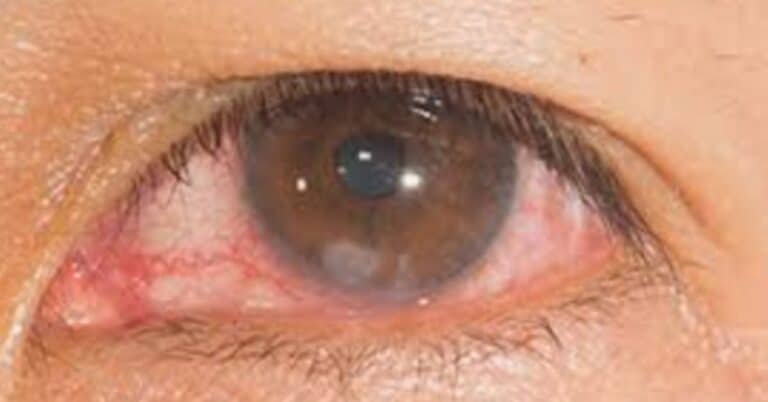
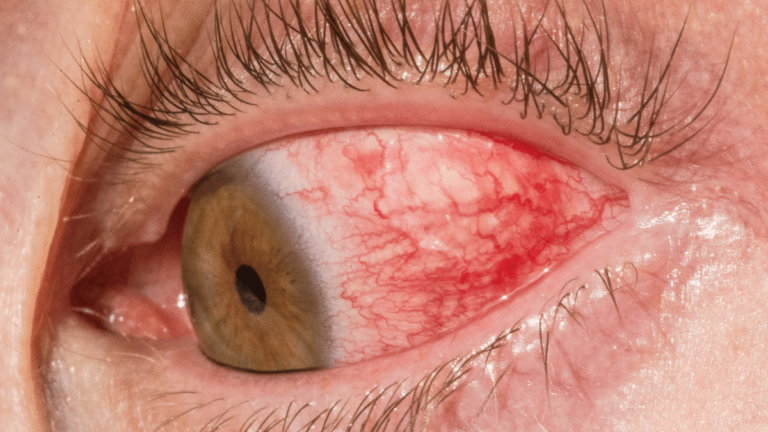
A red, painful eye suggests that the problem is in the eye itself rather than referred from elsewhere.1 Where the redness sits adds a further clue. Redness spread evenly over the white of the eye, with itching or discharge and no real pain, fits conjunctivitis. Redness concentrated in a ring around the cornea suggests inflammation inside the eye, such as uveitis or angle-closure glaucoma.1,11 A very red, painful eye needs an examination the same day.3 Redness without much pain has a different set of causes, explained in our guide to what causes red eyes.
Eye pain with blurred or reduced vision
Pain with any change in vision needs an examination the same day.3 Sudden or marked loss of vision, or eye pain with vision loss in a contact lens wearer, is an emergency.3 The kind of blurring matters too. A simple scratch rarely changes vision.19 Faded colors suggest the optic nerve.13 With conjunctivitis, blurring from discharge clears when you wipe the eye; blurring or light sensitivity that does not clear needs an examination the same day.3,29
Eye pain with light sensitivity
Squinting in bright sunshine is ordinary. Pain that light provokes is something else. Light is handled by the iris, the colored ring that narrows the pupil; focusing is a separate job, done by the lens.30 When the cornea or the front of the eye is inflamed, as in uveitis, the ciliary muscle inside the eye can go into spasm, and bright light makes the pain worse.1 The pupil reflex works in both eyes at once, so doctors can shine a light into the healthy eye while the painful one stays closed. Pain felt in the closed eye is called true, or consensual, photophobia. It suggests a corneal problem or uveitis, but it is a clinical clue, not a diagnosis on its own.1 Migraine can also make light uncomfortable, usually with a throbbing headache.1
New, marked light sensitivity with eye pain needs an examination the same day.3 It needs emergency care if it comes with sudden loss of vision, a red eye with halos or vomiting, or a stiff neck.3,5,9
Eye pain with headache, nausea, or halos
A red, painful eye with a headache, colored halos around lights, nausea, or vomiting is the classic presentation of acute angle-closure glaucoma, and vision can be lost quickly and permanently.5 Because the headache and sickness can dominate, the eye is easy to overlook, but it is an emergency even when they seem to be the main problem.25 Migraine can also bring headache, nausea, and light sensitivity, but a headache that comes on suddenly and is extremely painful, or one with lost or double vision, needs emergency care.1,15 Migraine aura that lasts longer than an hour needs medical advice the same day.15 Our guide to headache behind the eyes covers headache patterns in more detail.
Eye pain with discharge or watering
Watering is common with a scratch or a trapped particle.3 Discharge that is white, yellow, or green points toward an infection of the conjunctiva, and sticky discharge can spread to others.12,29 With discharge, the warning signs are severe pain, light sensitivity, or blurred vision that does not clear.29 Newborns are the exception to any wait-and-see approach: a baby under 30 days old with red, sticky eyes needs to be seen by a doctor the same day.12
Eye pain with eyelid swelling
A tender, swollen lump at the edge of one eyelid is usually a stye, a small infection that causes redness, swelling, and pain.31 Swelling of the whole eyelid raises a different question: how deep does the infection go? A thin sheet of tissue, the orbital septum, runs from the rim of the eye socket into the eyelids and separates the lid from the socket behind it. Infection in front of it is preseptal cellulitis; infection behind it is orbital cellulitis.8 A red, warm, swollen eyelid may be caused by an infection in front of the septum, in the lid itself. Fever can occur in both forms, so it does not tell them apart.8,32 A bulging eye, painful or restricted eye movements, double vision, or reduced vision are warning signs that the infection may have reached the eye socket, and they need emergency care.8
Without those warning signs, milder swelling of the whole lid needs medical assessment the same day. Marked swelling, or swelling with a fever, is still treated as an emergency, because only an examination can show whether the infection has spread. Both infections are more common in children, and the milder, preseptal form is far more common than orbital cellulitis.8 Orbital cellulitis can, however, worsen very quickly in a child, so these warning signs should never be left to settle on their own.33 A young child may not be able to say that their vision is double or blurred. Watch instead for what you can see: an eye that bulges, eye movements that seem painful or restricted, or a child who seems generally unwell. Any of these needs emergency care, and so does swelling so marked that the eye cannot be checked properly.8,32
Eye pain with fever or double vision
Fever with eye pain suggests infection, most importantly orbital cellulitis, which usually spreads from the sinuses.1,8 Double vision can mean that the eye cannot move normally, which happens in orbital cellulitis; in someone over 50, it can also be a sign of giant cell arteritis.8,14 Either symptom with eye pain needs emergency care.8,10 Without eye pain, double vision still needs emergency care if it follows a head injury or comes with a severe headache, an enlarged pupil, a drooping eyelid, a bulging eye, or reduced vision.8,34,35 The same applies with signs of a stroke, such as a drooping face, weakness or numbness on one side, slurred speech, or confusion, even if they pass quickly.36 Any other new double vision, including double vision that comes and goes, needs an examination the same day. Double vision that comes and goes can point to a nerve or muscle disorder.34,35 Only long-standing double vision that has already been assessed and has not changed can wait for a routine appointment.
A fever can also point beyond the eye. Meningitis, an infection of the layers around the brain, can cause a severe headache that keeps getting worse, a stiff neck, and eye pain when looking at bright lights.9 Not everyone has every symptom, and not everyone gets a rash, so do not wait for one. No single symptom proves meningitis, and no fixed set of symptoms is needed before seeking help. The warning signs in the emergency box, or a strong sense that someone is seriously unwell, are reason to seek emergency care at once.9
Eye pain with a rash on the forehead or face
Shingles that affects the ophthalmic branch of the trigeminal nerve can involve the forehead, the upper eyelid, and the eye. Pain or tingling of the forehead can come before any rash appears, and once the eye is involved it can become very painful, red, and sensitive to light.17 A blister on the tip of the nose, known as Hutchinson’s sign, suggests that the nasociliary branch of that nerve is involved and makes eye involvement about three times more likely. Eye complications can still occur without it.17 A shingles rash on the forehead, eyelid, eye, or nose needs an examination the same day, even if the eye does not yet look affected. Antiviral medicine works best when started within three days of the rash appearing.17,18 Blisters on the eyelid can also come with a herpes simplex infection of the eye.37
Situations that change the meaning of pain
Some circumstances lower the threshold for care, whatever the pain feels like.
If you wear contact lenses
Contact lens wear is the most common cause of bacterial corneal ulcers, especially when lenses are slept in or not disinfected properly.38 Corneal infection makes the eye very painful, watery, and sensitive to light, sometimes with a white patch on the cornea.39 If your eye becomes red or painful, take the lens out and leave it out until an eye care professional says it is safe.40 A painful red eye in a lens wearer should be examined the same day.10 Go to an eye emergency service or emergency department now if your vision gets worse, or if the pain or light sensitivity becomes severe or worsens quickly.3,40 Read more about contact lens safety.
After eye surgery or an injection
Some discomfort after an eye procedure is expected; the direction it takes is what matters. After cataract surgery, some itching, discomfort, and light sensitivity are normal for a day or two. Pain that persists despite pain relief, a very red eye, new floaters or flashes, or any loss of vision is not normal: call the surgical team right away.6 After an injection into the eye, a red patch on the white of the eye is common. The eye may be tender for a day or two, but it should not become more painful. Eyesight that worsens or turns misty, redness spreading over the whole eye, a deep ache in the eye socket, or more floaters can be early signs of infection. If any of these appear, go to an eye emergency service or emergency department.7 Severe pain or loss of vision in the four weeks after any eye procedure is an emergency.3
After an injury or chemical exposure
First aid comes before everything else. Rinse a chemical splash at once with clean water for at least 20 minutes, and never rub, press on, or try to remove an object in the eye.4 A blow to the eye can also cause trouble that appears later. Pain and light sensitivity that begin days afterward can come from inflammation inside the eye, and they should be examined the same day.1,10
How soon should you be seen?
Emergency: any of the signs in the emergency box.
Same day, meaning an examination by an eye care professional today:3
- Severe eye pain without any of the emergency signs2,3
- A painful red eye in a contact lens wearer
- New and marked sensitivity to light, pain that keeps getting worse, or new blurred vision
- A shingles rash on the forehead, eyelid, or nose18
- Over 50, with a new headache, scalp tenderness, or jaw pain when chewing, and no change in vision14
Routine appointment: mild discomfort that has lasted more than a couple of days, recurrent grittiness or eyelid trouble, and aching eyes after close work.2 An eye exam can confirm the cause. Our guides to the causes of eye pain and eye pain treatment describe the conditions and what helps once the cause is known.
Describing your pain to a doctor
A clear account shortens the path to a diagnosis. Before the appointment, note when the pain started and whether it came on suddenly, what it feels like, how severe it is, and whether you have had it before.1 Say whether one or both eyes hurt, whether the pain is in the eye or around it, whether it is worse when you move your eyes, and whether light bothers you.2 Mention contact lens use, recent eye surgery or injury, work with metal or welding, and conditions such as arthritis, an autoimmune disease, multiple sclerosis, or migraine.1
The examination then answers what symptoms cannot. The doctor checks your vision, pupils, and eye movements, and looks at the cornea under a microscope after staining it with a dye that shows scratches and ulcers. Eye pressure is measured when glaucoma is possible.1,2 A simple test can help: if a numbing drop takes the pain away, the source is usually the surface of the eye.2
Frequently asked questions
Does worse pain mean a more serious problem?
Not reliably. A corneal scratch can hurt intensely, because the cornea is so sensitive, and still heal within one to three days.1,19 Optic neuritis may cause only mild pain while vision is affected.1 Severity still counts. Severe pain needs an examination the same day, and emergency care if it came on suddenly. A change in vision needs an examination the same day too, even when the pain is mild.3
Can eye pain be serious if the eye is not red?
Yes. In optic neuritis, the eyelids and cornea usually look normal even though vision is affected.1 Giant cell arteritis can also lead to loss of sight, with a headache and scalp tenderness as the main symptoms.14,28
This article explains what eye pain symptoms can suggest. It cannot diagnose an eye problem; an examination can.
Sources and medical references
Show all 40 sources
- Merck Manual Professional Version. Eye pain (opens in a new tab)
- MedlinePlus (U.S. National Library of Medicine). Eye pain (opens in a new tab)
- NHS. Eye pain (opens in a new tab)
- NHS. Eye injuries (opens in a new tab)
- Merck Manual Professional Version. Angle-closure glaucoma (opens in a new tab)
- National Eye Institute. Cataract surgery (opens in a new tab)
- Royal Berkshire NHS Foundation Trust. Advice following an eye injection (April 2025) (opens in a new tab)
- Merck Manual Professional Version. Preseptal and orbital cellulitis (opens in a new tab)
- NHS. Meningitis (opens in a new tab)
- Moorfields Eye Hospital. Emergency conditions (referral criteria) (opens in a new tab)
- Merck Manual Professional Version. Red eye (opens in a new tab)
- NHS. Conjunctivitis (opens in a new tab)
- Merck Manual Professional Version. Optic neuritis (opens in a new tab)
- NHS. Temporal arteritis (giant cell arteritis) (opens in a new tab)
- NHS. Migraine (opens in a new tab)
- Moorfields Eye Hospital. Recurrent corneal erosion syndrome (opens in a new tab)
- Merck Manual Professional Version. Herpes zoster ophthalmicus (opens in a new tab)
- NHS. Shingles (opens in a new tab)
- Merck Manual Professional Version. Corneal abrasions and corneal foreign bodies (opens in a new tab)
- NHS. Cluster headaches (opens in a new tab)
- National Eye Institute. Dry eye (opens in a new tab)
- Merck Manual Professional Version. Scleritis (opens in a new tab)
- National Eye Institute. Uveitis (opens in a new tab)
- NHS. Uveitis (opens in a new tab)
- National Eye Institute. Glaucoma (opens in a new tab)
- National Eye Institute. Get a dilated eye exam (opens in a new tab)
- NHS. Sinusitis (sinus infection) (opens in a new tab)
- Merck Manual Professional Version. Giant cell arteritis (opens in a new tab)
- National Eye Institute. Pink eye (opens in a new tab)
- National Eye Institute. How the eyes work (opens in a new tab)
- Merck Manual Professional Version. Chalazion and hordeolum (stye) (opens in a new tab)
- Canadian Paediatric Society. Preseptal and orbital cellulitis in otherwise healthy children and youth (practice point, 2026) (opens in a new tab)
- MedlinePlus (U.S. National Library of Medicine). Orbital cellulitis (opens in a new tab)
- NHS. Double vision (opens in a new tab)
- Merck Manual Professional Version. Diplopia (opens in a new tab)
- NHS. Symptoms of a stroke (opens in a new tab)
- Merck Manual Professional Version. Herpes simplex keratitis (opens in a new tab)
- Merck Manual Professional Version. Corneal ulcer (opens in a new tab)
- MedlinePlus (U.S. National Library of Medicine). Corneal ulcers and infections (opens in a new tab)
- Moorfields Eye Hospital. Contact lenses (opens in a new tab)